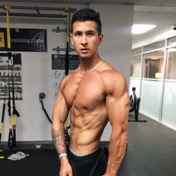
Across 9 decoded pieces of advice. This scores the state of the evidence behind what they say — not them, and not their honesty. Good creators cover contested ground; that shows up here as mixed.
The body-fat benchmarks cited for ab visibility (roughly 15-20% for men, 18-25% for women) and the recommended loss rate (0.5-1% of bodyweight per week) match standard sports-nutrition reference points. The video's strongest point is the sleep comparison: a randomized controlled trial (Nedeltcheva et al., Annals of Internal Medicine, 2010) found that cutting sleep from 8.5 to 5.5 hours during a matched calorie deficit reduced the fraction of weight lost as fat by about 55% and increased lean-mass loss by about 60% — exactly the mechanism the video describes. The narrative itself is a two-person case study (Luke and Nicole), not generalizable proof on its own, but both underlying mechanisms (fat-percentage threshold for visible abs, sleep's role in preserving muscle) are well grounded in the literature. The correction to the '90-day abs' myth is honest and useful.
Jeremy Ethier offers a useful ceiling: somewhere around 0.6-0.7g per pound (1.3-1.6g/kg) of bodyweight, you've captured most of protein's contribution to muscle growth, and eating more barely moves the needle further. That number lines up well with the landmark dose-response meta-analysis on the topic (Morton et al., 2018, British Journal of Sports Medicine, 1,863 participants), which places the breakpoint at 1.62g/kg/day — but the citation he actually gives (Nunes et al., 2022, Journal of Cachexia, Sarcopenia and Muscle, PMID 35187864) is a different meta-analysis that doesn't find quite as clean a plateau: it shows a positive effect that keeps going, albeit modestly, past 1.6g/kg, without pinning down a hard ceiling. A more recent, detailed re-analysis of the Morton data (Nuckols, 2024, Stronger by Science) argues the 1.62g/kg 'breakpoint' rests on a fragile statistical method, and that the real ceiling for maximizing muscle gain sits closer to 2.0-2.35g/kg. The core message — training matters far more than the last gram of protein, and most people already eat enough — holds up and does real good by de-dramatizing the protein-counting obsession, but the specific number is a bit conservative and attached to a citation that isn't quite the one that established it. Verdict: mixed.
Stripped from the rest of the video (training volume, protein, creatine), the sleep claim checks out in the acute-deprivation literature: a randomized crossover trial (Physiological Reports, 13 adults) found that a single night of total sleep deprivation cut postprandial muscle protein synthesis by about 18%, dropped testosterone by about 24%, and raised cortisol by about 21%; another crossover trial found a significantly bigger exercise-induced growth-hormone response after a sleepless night than after normal sleep — a spike that offsets a deficit rather than improving on it. The direction is consistent across studies, but sample sizes are small (n=10-13). The "practical fixes" named (eye mask, earplugs, cool room, naps) weren't tested in isolation in these same trials, but they line up with well-established sleep-hygiene levers. This matters most if you train seriously — an occasional 6.5-hour sleeper isn't going to see muscle gains collapse overnight; the effect compounds with training intensity and consistency.
Stripped of the show's framing (the sponsor mention, the two-participant narrative), the protein point in this video holds up well. A randomized controlled trial (Longland et al., 2016, American Journal of Clinical Nutrition) compared 1.2g/kg/day against 2.4g/kg/day of protein in overweight men during a steep 4-week, 40%-calorie deficit combined with resistance and interval training: the higher-protein group gained lean mass AND lost more fat mass, while the lower-protein group's lean mass barely moved. A broader review (Barakat et al., 2020, Strength & Conditioning Journal) confirms this 'body recomposition' — building muscle and losing fat at once — shows up most clearly in novice or higher-body-fat individuals, and to a lesser but real extent in trained lifters too, provided protein intake is high (often >2g/kg/day) and resistance training is structured. The 'skinny fat' profile the video targets — low muscle, more fat than appearance suggests — is exactly the population where this effect is most consistently documented. Verdict: holds up.
The 2026 ACSM Position Stand sets the critical threshold at at least 2 sessions per week per muscle group, and explicitly states that training all major muscle groups at least twice a week matters far more than chasing a 'perfect' program — directly validating the full-body 3x/week format. The 2023 PLOS ONE meta-analysis on trained women found upper body progresses better with 13-20 reps and lower body with 1-6 — consistent with the claim, though the study documents an upper-vs-lower-body difference within women rather than a direct male-vs-female comparison in the same protocol; the simplification 'women tolerate higher reps better than men' is a reasonable but slightly loose reading of what the literature precisely shows. The rest (progressing via harder variants, adjusting to individual body structure) reflects well-established programming practice. Verdict: holds, with a minor nuance on the precision of the male-vs-female comparison.
Stripped of its "myth-test" format, the core zone 2 claim is well-founded and consistent with the Storoschuk et al. (2025) review: yes, at zone-2-type intensity the body proportionally burns more fat as fuel during the effort — but body-fat loss over time depends on total daily calorie balance, not the percentage of fat burned during one specific session. That's a correct technical distinction, frequently blurred in fitness marketing. The other test reported (walking vs. running over the same distance) is consistent with exercise physics: over an identical distance, the mechanical work and therefore total calorie cost are close, even though per-minute intensity differs — which is why several studies find walking and running comparably effective for weight loss at matched distance. The video's format (before/after measurements, metabolic cart) is a reasonable methodology for this kind of comparison, even though it's popular-science content rather than a peer-reviewed publication itself.
Source cited in the video: a Doctor of Sports Nutrition consulted by the creator, plus named studies (a 2023 analysis on turkesterone underdosing, a 1972 trial on the placebo effect). Evidence type: a narrative review built on controlled trials. The grounding confirms the ranking: three separate randomized trials published in 2024-2025 (MDPI; Research in Health and Medicine; Journal of the International Society of Sports Nutrition) found no effect of turkesterone on IGF-1, body composition, or strength in humans, at doses up to 2000mg/day — the video is in step with an already clearly negative literature here. Creatine (3-5g/day monohydrate) remains the best-established supplement for strength and lean mass in resistance-trained people. Protein powder only adds real gains when total intake sits below target (~0.7-1g/lb); above that, it mostly adds convenience. Over-the-counter testosterone boosters only nudge testosterone within the normal range, except when correcting a genuine zinc, magnesium, or boron shortfall. Direction: likely causal for creatine and protein (controlled trials), null for turkesterone and boosters.
The central thesis — that the dose-response relationship between protein and hypertrophy flattens well before extreme intakes — holds up, though the exact "62 studies" figure cited in the video couldn't be independently confirmed in this grounding pass. The reference meta-analysis on the topic (Morton et al. 2018, 49 trials, 1,863 participants) finds a lean-mass plateau at 1.62 g/kg/day (95% CI: 1.03-2.20), and more recent dose-response meta-analyses (Nutrition Reviews, spline modeling) confirm the effect slows sharply past 1.3-1.5 g/kg/day. Doubling an already-adequate intake doesn't double results — a lifter at 1.4 g/kg/day who jumps to 2.8 g/kg/day won't see twice the muscle. "Stop buying more protein than you need" is well-supported by the literature, even if the exact identity of the cited 62-study meta-analysis needs checking against the original source.
The central argument matches the exercise-physiology consensus: fat loss is driven by total energy balance over the week, not by the fuel-source split during a single session. The video correctly debunks two persistent myths — the low-intensity 'fat-burning zone' and fasted cardio as a fat-loss accelerator — a point matched by the fasted-training literature (controlled trials show a trivial effect on body composition at matched calories, even though in-session fat oxidation is higher fasted). The measurement protocol (two testers, wearable trackers) is informal self-experimentation, not a controlled trial, so the specific per-exercise numbers are illustrative rather than published findings. The overarching message — pick the cardio you'll actually sustain rather than whichever 'burns the most fat' on paper — holds up well against the literature.